Overview
As part of the Indie Games elective during an earlier semester of my studies, I worked on the planning and development of a mobile puzzle game as part of a four-person team. The course focused not only on implementation, but also on the practical aspects of budgeting, scope definition, and production planning for small independent game projects.
| Alexander Schuster | 3D Art |
| Mengdi Wang | Programming |
| Alexander Epple | Programming Lead, UI |
| Mohamed Haddej | Sound |
The resulting game, Kings of Dominia, is a mobile puzzle game set in a medieval fantasy environment. The objective is to create a chain reaction that reaches and topples the opposing king. This is achieved by placing and upgrading dominos and by configuring cannons to bridge gaps in the environment.
Trailer
Gameplay
The gameplay was designed to be intuitive on touchscreen devices while still allowing for level-specific problem solving. The in-game UI supports actions such as reloading a level and undoing placements or upgrades, which makes experimentation straightforward for the player. A level is completed once the domino chain reaches the enemy king and causes it to fall.


The main interaction mechanic is the placement and modification of dominos. This is performed in a dedicated edit mode, which separates planning from execution and helps keep the interaction model clear.
Domino placement is based on a touchscreen gesture: the player draws a path across the level, and the game automatically places dominos at suitable intervals along that path. The spacing is chosen to preserve a valid chain reaction while remaining easy to control on a mobile device. Standard dominos are available without restriction and can be placed on most flat surfaces.
Previously placed dominos can also be upgraded through direct selection. The prototype includes three upgrade types:
- Explosive domino: destroys obstacles on impact
- Ice domino: slides over a distance after falling
- Long domino: provides extended reach through increased size
These upgrades are limited and are required to solve specific level configurations. They are used to overcome obstacles such as walls, staircases, and blocked passages, encouraging players to identify an effective sequence of placements and upgrades rather than relying on trial and error alone.


Some parts of the environment, such as lava and stairs, do not allow direct domino placement. In these situations, cannons are used to continue the chain reaction. Cannons can be rotated, and their projected trajectory is shown to the player. They are activated when a domino reaches the corresponding trigger pad.
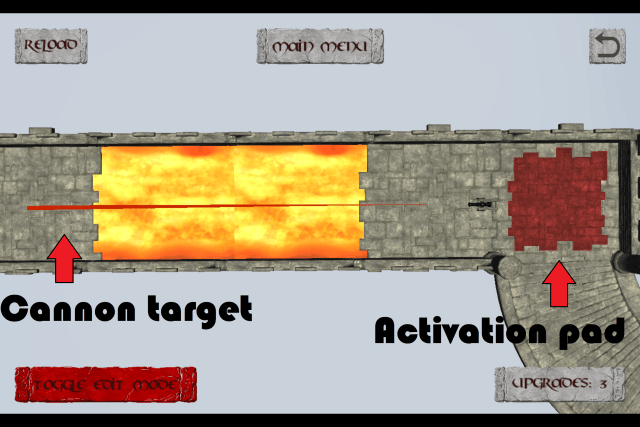
To support iteration and reduce frustration, the game includes an undo function for recent actions as well as the option to reload the current level.
Once the setup is complete, the player starts the simulation by activating the first domino, represented by their own king. At that point the chain reaction runs to completion, and no further editing is possible.

Conclusion
The project resulted in a functional prototype with three fully playable levels and a clearly defined core mechanic. The game could be extended further with additional content, and while mobile performance still offered room for improvement, the central interaction and puzzle systems worked reliably.
In addition to leading the programming work, this project gave me practical experience in UI design, mobile interaction design, and collaborative development within a scoped production setting. The final presentation also included a short trailer, which is linked below. The project is available as downloadable builds for touch-enabled Windows devices and Android, and the source code can be found on GitHub.